Steve Magas is Ohio's Bike Lawyer. He has written about Ohio Bike Laws, bike crashes, bicycle advocacy and court cases for some 30 years. Soon we'll be adding a series of features about your favorite Ohio bike shops.
I imagine this will become an annual post to remember Emilee Gagnon who was KILLED by LYNNE SMITH. I wrote about LYNNE SMITH’S CONVICTION … and her post conviction motion to HIDE HER CONVICTION here… but the story is worth reviewing today in light of ANOTHER cyclist killer up in the Toledo area who is whining about his sentence – discussed below…
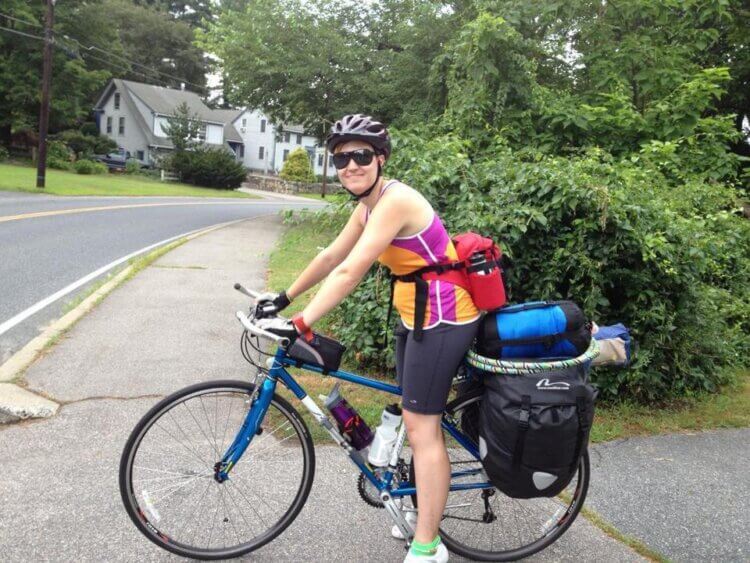
On September 23, 2013, Emilee was riding her loaded touring bike cross country on a charity, fund raising trip. As she was preparing to end for the day near Toledo she was riding along State Route 163 near Genoa, Ohio.
Now, if you don’t know, mid-September -and mid-March- are the times of year when the sun rises & sets on its most East/West line… hence the equinox times…
You didn’t know that did you?
These times present the worst Sun Glare on Ohio’s east/west roads at sunrise and sunset. Despite this phenomenon occurring for the past untold millennia motorists remain… SHOCKED, SIMPLY SHOCKED… to find the sun in their eyes at sunset on westbound roads… completely surprised, taken aback and confused by the presence of the giant ball of light that impairs their vision and ability to see what is in front of them…
Screenshot
OF course, they always… slow down… right… right???
Of course NOT… many motorists just keep motoring along secure in their knowledge that their 2 ton bowling balls can obliterate whatever is in front of them.
That’s what LYNNE SMITH did… she encountered a blinding setting sun on a fast, westbound road and kept on going… she slammed into Emilee, who was on teh BERM riding towards her final destination that was just a few minutes up the road. Emilee was killed –
Lynne Smith was charged with … a misdemeanor… of course, but hey, why would KILLING SOMEONE with your car be a felony?
Lynne Smith plead down and accepted a conviction on second degree vehicular manslaughter charges. Despite a risk of a max of a whopping 90 days in jail, she was sentenced to… TA DA… ZERO days behind bars… Rather, the court put her on probation for 2 years, wagged his finger at her and sent her on her way. By all accounts, Smith served her sentence and finished her probation.
We’ve been getting calls these days from folks who have been injured in crashes asking about things they’ve learned from ChatGPT or other AI-based sources. They are asking questions like:
What should I do after my bike crash?
Do I have a claim? How do I know?
How do I present a claim?
Do I even NEED a lawyer?
And, of course, the Big One: WHAT’S MY CLAIM WORTH?
Perhaps it is time for a bit of a Primer on these issues!
CLAIMS ARISING OUT OF A BIKE v CAR CRASH
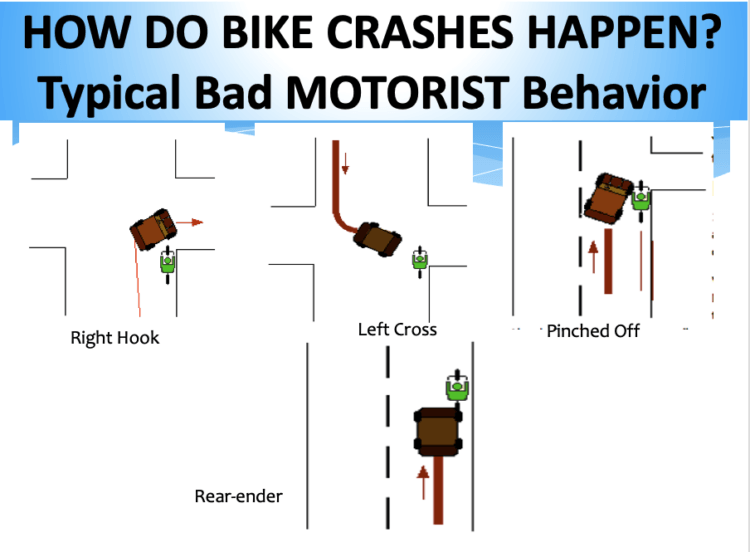
You were riding along on the road and got whacked by a motorist. You were, you thought, doing everything right and the motorist, you believe, screwed up and hit you. This probably occurred in one of the four most common Car/Bike Crash scenarios: Right Hook – Left Cross – Rear Ender – Passing/Pinched Off
Assuming you were doing everything right, and the motorist did something wrong and hit you and caused you to be injured then, at that very moment, a new “CLAIM” was born. This claim is a “thing” – it’s YOUR thing. It belongs to YOU. This claim has some “value” – money value – but only in a very special marketplace and only to one very special person/entity- the insurance company for the person who hit and hurt you. At some point in the future, this insurance will want to buy your claim from you. The insurer wants to pay THE LOWEST POSSIBLE PRICE to you, just like the person who buys your used car wants to pay the lowest possible price for your car.
Does this mean the insurer is “Bad” for not paying you what you want? No, the insurer is a Business and YOU are a NUMBER to them. They want to maximize profits by minimizing what they pay out in claims. The insurer has trained its representative and adjustors to seek out and highlight all the factors in your claim that they can use to diminish the value then argue with you until you submit to their way of viewing your claim.
In a claim of any real value, YOU should have someone on YOUR side who is trained to deal with the insurer- and trained to MAXIMIZE the value of your claim by developing the claim in such a way that the value is clearly seen.
I have had this lithograph – “The Advocate” – in my office since the early 1980s – I’ve always carried this idea of the Lawyer for the victims fighting for Justice & shielding his clients from the aggressive tactics of folks coming at him or her… that’s what we do in these Bike Cases – we understand the process – we understand what factors give your claim value – we how insurers “think” – we understand how to present the facts, data, medical evidence and pain and suffering to the insurer in such a way as to cause the insurer to pay the most it will pay, and then some, to “buy” your claim from you. And…if the insurer balks at paying a fair price to buy your claim, we have the skillset needed to get your case into the court system and take it to trial if necessary.
THE CLAIMS PROCESS
I’ve been handling “insurance claims” for over 40 years now. Despite all the changes the world has seen, the basic claims process has not changed much. A claim is opened – data from the crash, injuries and such are provided to the insurer – the data is analyzed and the insurer develops its view of the value of the claim. They are experts at this – and experts at MINIMIZING their exposure and pay out. My job is to present the claim in the best possible light – counter any arguments they have on claim and get the insurer to pay out a sum that is…uncomfortable… to the company – to get every dime they want to pay, and then some.
The “claims process” starts the moment the insurer is notified about the crash. The insurer opens a new claim, assigns that claim a unique Claim Number, assigns a Claims Rep or Adjustor to handle the claim, and immediately starts going through its protocol for gathering information to assess the claim.
How does the insurer find out about the crash. Well, a “good” motorist notifies the insurer – tells the insurer “Hey I screwed up and caused a crash and hurt somebody on a bike.” But… that often does not happen. Just this week alone I have contacted three different insurance companies to open a claim because the At Fault driver failed to notify their insurer.
When a person hires us to handle their injury claim we immediately have a lengthy Day 1 To Do list – We will FULLY investigate the claim-gather all police records/photos/video – get all witness statement- get Cruiser/Body Cam – 911 calls – security video- Toxicology or other Forensic reports- get any crash reconstruction data, Black Box data, Measurements – TALK to witnesses – LOOK FOR other security cam or Doorbell cam footage – Think about whether this is a case where a Crash Reconstruction Expert is needed – would the Black Box in the car yield any important data? If so, we may need to file a lawsuit on Day 1 and secure the data with a Temporary Restraining Order.
We will also notify the driver, and their insurer of the crash, your claim & our involvement. We’ll send a Notice to Preserve Evidence, demanding that any cell phone and other data in the car be preserved… the phone itself, any data ON the phone and all the billing records.
We will demand that the CAR and its Black Box be preserved. We typically cannot “GET” that phone/black box data without a subpoena but… we will put the driver on notice that they must preserve it. If they don’t preserve the data they could be a risk for another claim for “spoliation of evidence.” Also, if they’ve been told to preserve, say, their cell phone & its data/messages, etc and, when asked about it during a deposition they say “oh… that phone broke, so I got rid of it…” it can sound VERY shady to a judge or jury…
We will want the driver to notify the insurer. Today, the investigating officer in Ohio is SUPPOSED to check and confirm insurance coverage for the driver… sometimes they do that – sometimes they don’t. The LEO is also SUPPOSED to put the insurance company & policy number in special boxes on the crash report and… Ta Da… sometimes they do that and sometimes they don’t. Frankly, we seem to see Police take a more lackadaisical approach to crash investigation when cyclists are the victim. Sometimes we have to fight with the victim just to get the name of their insurer…
The initial communications with the insurer are VERY important. What you tell, or don’t tell, the insurer Day 1 can impact how easy or hard it is to resolve the case on Day 400. Our initial communications & correspondence with the insurer is both Tactical and Intentional.
When I was an in-house lawyer for an insurance company I definitely learned how important those communications are and I try to use those lessons when dealing with the assigned adjustor. In the “Olde Days” when I was a young lawyer using a quill pen to write to the insurer on parchment, insurance adjustors were almost always aggressive, angry, overworked, obnoxious older men who would belittle the lawyer and her/his client from Day 1 until the day they cut the settlement check. Not so much any more. Still, it helps to communicate effectively and develop a rapport through honest and open discussions with the adjustor.
[Oh…and I STILL use a very nice fountain pens to sign letters, printed on our letterhead]
When we get a case we handle everything – all communications – all data gathering – we obtain all medical records from all of your treatment – we obtain all the bills – we think about whether medical experts might be needed in a severe injury/TBI case.
Your job is simply… to get better. And to keep us in the loop so we can order all the bills and records we need to present your claims. When you’re all better we will put all the data into one big package – The Settlement Demand Package. I review every piece of better, every medical record and bill. I put it all into one fairly lengthy letter to the insurer that outlines the Liability & Damages facts: the crash, injuries, treatment, pain and suffering. At the end we ask for a dollar amount called our Opening Demand.
The BIG Question everyone has is: “What’s My Claim WORTH?”
The answer is… Ta Da … complicated… but nobody on planet Earth can give you that answer on Day 1. The “Value” of an injury claim depends on… Ta Da… the nature and extent of the injuries, the treatment, the medical bills, and many other factors that NOBODY knows on Day 1. It also involves WHERE the crash occurred. Claims in NYC are going to be valued differently than claims in rural Ohio.
Ohio is an interesting jurisdiction. We are the 7th largest state. That fact surprises a lot of folks. There are almost 12 MILLION people in Ohio. We lack the superHugeMega City like NYC or LA or Chicago or Houston but we have several good sized metropolitan areas, along with a lot of rural space. Ohio has 88 counties and I’ve had cases in many/most places here. I just filed a lawsuit in Van Wert County, my first time there. The same crash case likely has a different value in West Union than it does in Ashtabula or Toledo or Bellefontaine or Marietta! It takes some experience to figure that out.
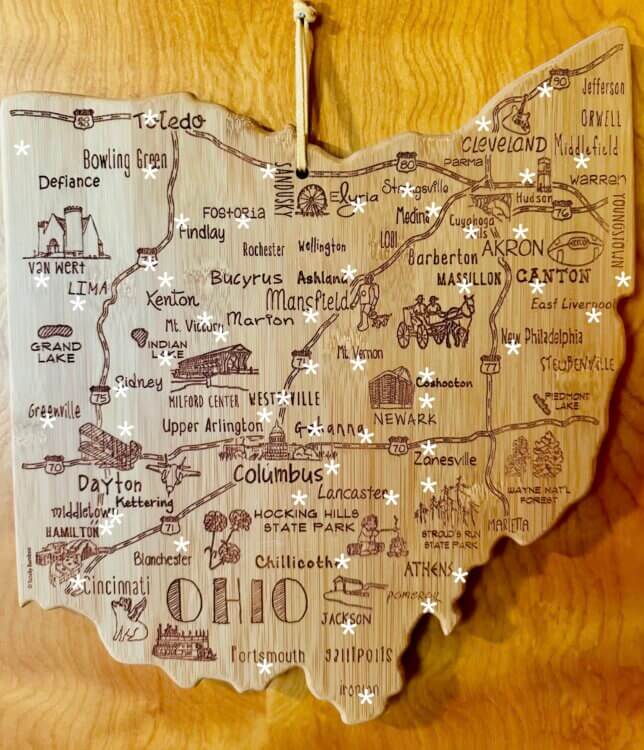
I found this cutting board, an Ohio map, and marked some of the spots where I have handled injury cases, mostly Bike cases, but also car, truck, and motorcycle crash cases.
Having said that, I think I can pretty well gauge the numbers of 0’s in your claim value pretty early in the process. Is your claim value from $10,000 – $99,000 or “Six Figures” or beyond? If you have the right background and experience, this is are difficult to see fairly early in the game for the most part.
Why?
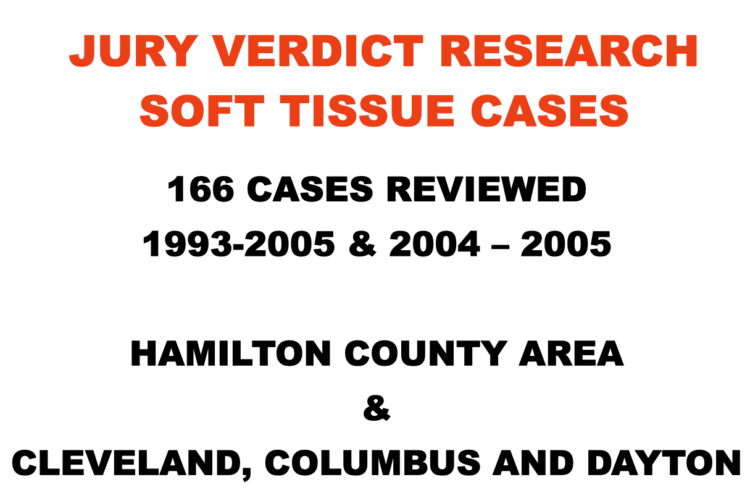
Well, I’ve handled 1000s of injury claims from Day 1 to Settlement – Day 1 to Trial & Verdict – Day 1 to Trial & Appeal. I’ve worked with all types of clients and insurance companies. Following trials, I’ve talked to juries about why they evaluated claims the way they did. I’ve been involved in mock juries. I’ve researched & written & presented seminars to lawyers & judges about jury verdicts and the factors lawyers listed that led to the verdict.
Also, I handle bike cases through, usually, a “Contingent Fee” agreement. What does THAT mean? Well, that means I ONLY get paid if we are successful & there is money in the bank. My fee is a percentage of what we are able to collect. We also advance costs, which means I basically pay, up front, the case expenses, hundreds, or even thousands of dollars. We get reimbursed at the end.
When I went out on my own I learned very quickly that if I made a mistake on Day 1 – took in, worked up, and spent hours and hours developing, a case that turned out to be a loser, or which had a value less than I thought then… well… I didn’t eat. The Contingency Fee means the client NEVER GETS A BILL. The lawyer takes the risk and spends time & money and may never get paid. I learned VERY QUICKLY to get really good at Picking The Winners on Day 1!! That meant learning to evaluate the Big 3 – Liability – Damages – Insurance – early in the case and to get it right.
So, in addition to “Big” damages and injuries, we look at a several other things on Day 1. First, “Liability” – who is at fault and why? How easy/difficult will it be to prove liability? Is the client telling me the truth – do the facts make sense? Does teh client tell the story effectively? Do they come across as truthful or does it seem like they are trying to make a mountain out of a molehill?
What does the police report say? This is certainly NOT determinative. As noted, police often side with the motorist over the cyclist. But, if the police are against you, it is a hurdle. We are very good at getting over those hurdles in the right case, but it is something we look at on Day 1.
So with Liability and Damages, the third thing we look for is, of course … INSURANCE! Does the driver have auto coverage? Does the client have an auto policy and/or excess coverage?
Can you go after a driver who is uninsured? Sure… but… it usually doesn’t make much financial sense. MOST people, if you turn them upside down & shake them, have more Debt than Cash. Most people can’t afford to pay any type of injury claim. If you do go after them, sue them, spend the time & money in litigation, go to trial and win a nice judgment, they can just file Bankruptcy and make the debt go away! It’s almost NEVER a good idea to take this route. THAT is why protecting yourself with good Auto/UM/Homeowners coverage is so important!
If you have a “big” claim – six figures and beyond – then you have significant, serious injuries and losses that were, typically, immediately recognized as such. You likely had injuries that were debilitating – that prevented you from working – that have some element of permanency. Your losses are substantial.
Big” claims like that are pretty easy to spot on Day 1 and Big Claims require LOTS of BIG WORK by good lawyers. Do NOT try to handle a claim like that by yourself. You simply lack the skills to do so, and, frankly, you are probably too close to the pain to evaluate the claim fairly. You should ALWAYS get a good Bike Lawyer involved in a claim involving serious injuries.
Some lawyers only want to handle “big” claims but MOST car/bike crash claims out there are in the “five figure” range, not the six figure range. The cyclist is hit and gets hurt – often seriously hurt – and they work hard to get better. They get treated at the E/R – follow up with their Primary Care doc – get sent to a specialist or maybe to Physical Therapy. Our cycling clients are unique in that THEY WORK HARD at getting better- they treat their therapy like a big hill – sometimes the docs have to say “Slow Down” but by and large cyclists get better, and get better faster than the medical team expected. These can still certainly be very serious claims and this category of claims probably makes up the bulk of the claims we see in our statewide practice.
When we take a case we will ask YOU some important fact questions about what YOU were doing. Were you actually on the ROAD, and not the berm, shoulder, sidewalk, tree lawn. What were the light conditions? Weather? What were YOU doing? Did you have your hands on the handlebars? Engaged in any “trick” riding? Riding “with” traffic, not against traffic [hopefully]. What lane were you in? Does that even matter? [Narrator: it MIGHT…] Where in the LANE were you? Does that even matter? [Narrator: It MIGHT…] Were you turning? Preparing to turn? Did you SIGNAL a turn? Does that even matter? [Narrator: It MIGHT…] What was your speed? What gear were you in? Did you use/wear anything to make yourself more conspicuous? Flashing lights- bright colors. Is that even REQUIRED by The Law? [Narrator: NO but… if you were in “dark” clothes it will likely be noted in the crash report]. Were you wearing a Helmet? Does THAT even matter? [Narrator: No… well… maybe… ] Did you take any evasive action? Does that even matter? [Narrator: well… maybe…]
The “Insurance” we’ve been talking about so far has been the auto coverage that, hopefully, the driver who slammed into carries…but…
A/ Not all drivers are insured and B/Not all drivers have ENOUGH insurance to pay your claim.
In Ohio, the “State Minimum” level of auto coverage is $25,000.00. That means a driver can “stay legal” as long as they carry an auto insurance policy with $25,000 in “liability” coverage… i.e., coverage that applies to crashes they cause. $25,000.00 is … not good. It is VERY easy to a routine post-crash hospital trip to the E/R to cost MORE THAN $25,000.00, let alone follow up care and treatment. By the time you add in wage loss, other out of pocket expenses, and your pain and suffering, that $25,000.00 policy is basically a down payment.
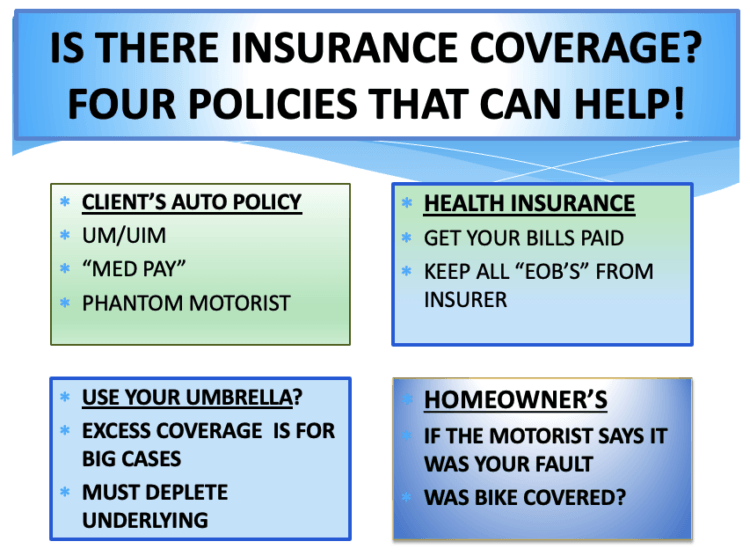
In my Bike Law 101 classes for lawyers & judges, I find that MANY lawyers are surprised to learn that a car/bike crash can trigger coverage and claims in FOUR or more insurance policies.
Say WHAT?
Yep. In addition to the other driver’s auto policy, we will dig into YOUR health insurance, YOUR auto insurance, YOUR homeowners insurance and YOUR umbrella or excess coverage. This is a slide from my BIKE LAW 101 Seminar.
YOUR HOMEOWNERS?
OK, I give up – how does your HOMEOWNERS policy come into play when a car slams into you while you are on a bike ride?
Well… there are actually TWO ways the H/O policy can come into play. We handle bike cases for many riders who spend… a LOT… on their bikes… like… a LOT [You KNOW who you are]. They spend so much that often insurance adjustors, who don’t get a lot of “car slams into expensive bike” cases, are shocked that we are submitting a claim for $5,000 or $10,000 or $15,000 … for a BIKE? The auto carrier will often nickel and dime us on these property damage cases [do Kids These Days even know what nickels and dimes are? But I digress…]
Cyclists often don’t realize that their bike is covered by their Homeowners policy. When they are struck by a car, they can present a claim to their H/O insurer, NOT their car insurer, for their property damage! We find that the H/O insurer often treats its insured, the cyclist, more fairly than, say, the offending driver’s auto carrier and we can get a better payout under the rider’s “replacement cost” coverage through the Homeowners coverage than we can through the other party’s auto coverage. Your H/O carrier will then go after the other insurer for reimbursement and, because it was NOT YOUR FAULT, they payout will not “count against you” or jack up your premium.
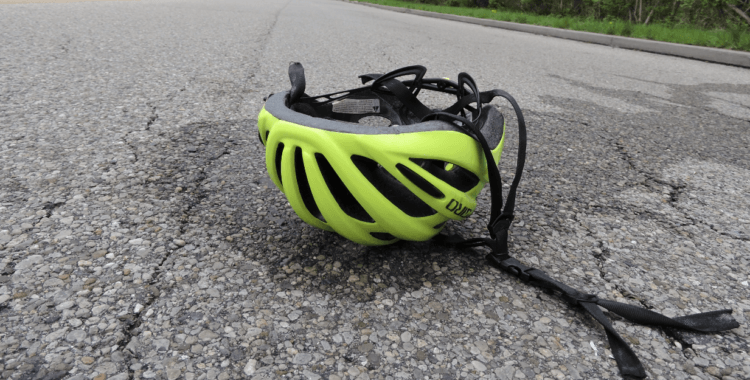
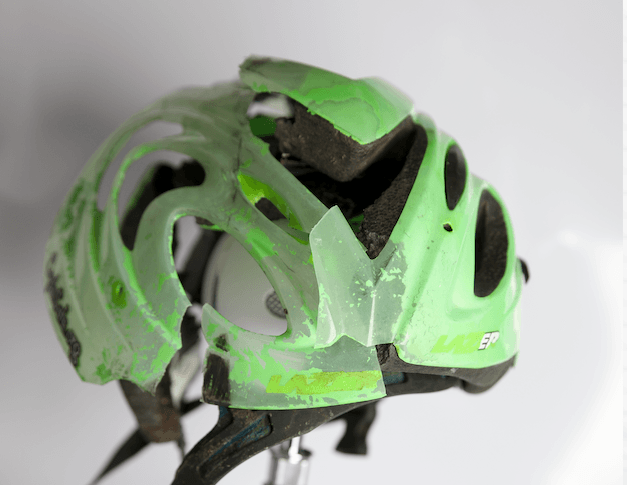
In addition to the bike, all the other expensive toys cyclists use are covered – watches, Garmin, Shoes, Jersey, Helmet, Glasses, etc… But DO NOT GIVE UP YOUR HELMET OR BIKE TO ANYONE. Sometimes the helmet company will say “Give us the smashed helmet & we’ll replace it for free!” Do NOT do this – that helmet is valuable evidence in your case. The Helmet Company is NOT being “nice” – they are taking potential evidence of a claim against THEM for a defective helmet out of the picture.
Sidenote: This H/O approach works for car/bike crashes, but would also work for, say, a dog attack where the bike was damaged. However, UM Coverage ONLY works for AUTO/Bike crashes. If a dog causes your injuries and the dog owner has little or no insurance you are out of luck…
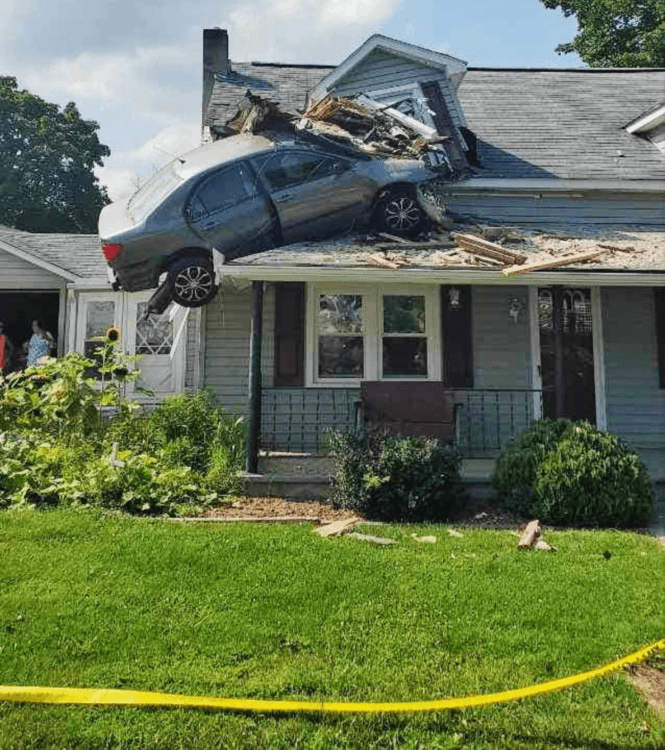
The second way your H/O policy can be used is if the motorist claims the crash was YOUR fault and comes after you for damage to their car. The “Liability” coverage of your H/O policy is there to protect you. If you get sued, your H/O insurer will hire counsel to protect you.
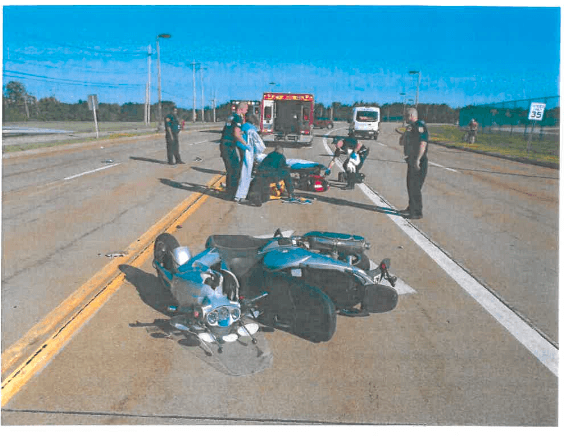
I’ve had several cases, mostly involving folks who ran into my cycling clients with motorcycles, where we have used the cyclist’s H/O policy this way. The cyclist hires me to handle their claim against the other side. The other side sues the cyclist. We notify teh H/O carrier who assigns a lawyer to defend the lawsuit. I then work with that lawyer – we share costs and data throughout the litigation. When I file a counterclaim against the other driver, they notify their carrier and they get a lawyer to defend the claims I brought. So now we have 2 parties and FOUR lawyers… sheesh…yes, it can get messy…
YOUR AUTO POLICY
Your auto policy has TWO coverages that might come into play. First, you probably have “Medical Payments” coverage. This is usually a smaller number – $1000 or $5,000 or $10,000 typically. I’ve seen $25,000 and even $100,000 policy limits in “Med Pay” coverage but that is pretty rare. This Med Pay coverage is like a mini-health insurance policy inside the auto policy. If YOU are involved in a “car crash” then this money is available to help YOU pay YOUR medical bills. This applies even if you are NOT IN A CAR. So if you are hit by a car while riding your bike, Med Pay applies. If you are standing at the bus stop and car hops teh curb and hits you… Med Pay applies. If you are sitting in your bedroom on the 2nd floot watching TV and a car comes flying in and hurts you… Med Pay applies.
In today’s world, with high deductibles and clients who lack significant savings to pay unexpected medical bills, this Med Pay coverage can be a pot of gold. You are hit by a car and your deductible isn’t met so you now owe $4500.00 to the E/R that treated you. We can often tap into your auto policy’s MED PAY coverage to get that paid.
Another typical coverage in the Auto Policy you may need to use is the “Uninsured/Underinsured Motorist” coverage. Again, this applies when the OTHER DRIVER is uninsured or underinsured [lacks sufficient coverage to pay your claim]. This UM/UIM coverage applies even if you were NOT IN YOUR CAR.
We URGE, STRENUOUSLY URGE, all cyclists who ride on the roads to think about buying as MUCH UM/UIM coverage as they can afford. It’s pretty cheap and can be a Life Saver when the idiot who slammed into you says “Oops, forgot to pay my premium and they canceled my policy…”
YOUR UMBRELLA/EXCESS POLICY
Umbrella Coverage or “Excess” coverage is an additional policy you can buy. It is very cheap – and it ONLY comes into play when all of your OTHER coverage is used up. So let’s say you are in a big crash and have a big case but the other driver has no insurance. You have $250,000 in UM/UIM coverage [YAY!], but the value of your claim is a lot more, say, $500,000.00 [BOO!]. If you have a $1.0 million “Umbrella” then that Umbrella can be used here because the $250,000 is insufficient to pay the claim. So even though the other driver had NO insurance, you can use the $250,000.00 from your UM/UIM and then another $250,000.00 from your Umbrella policy to receive the full $500,000.00 value of your claim.
Again, if you are on the ROAD a lot we URGE, STRONGLY URGE, you to get both UM/UIM and UMBRELLA Coverage… just make sure your umbrella doesn’t “…have a hole in it…” You can read about THAT issue here…
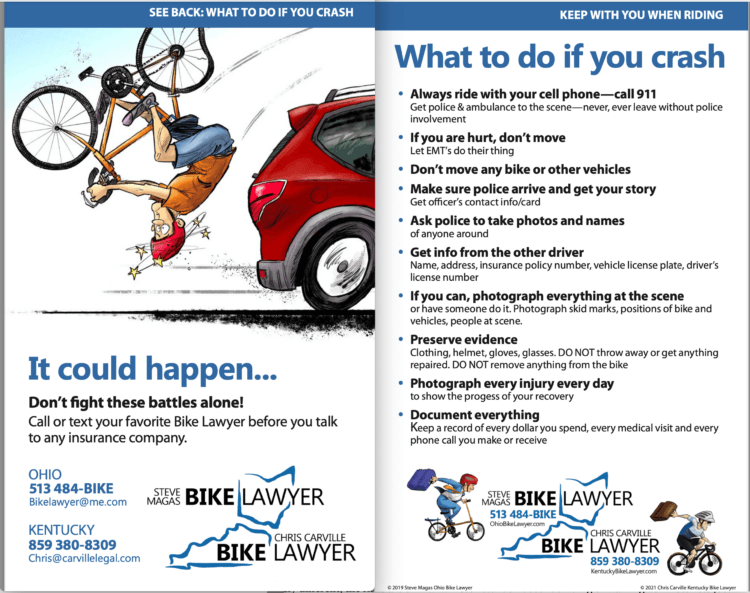
So… you got hurt in a crash… What should YOU do? Well, thankfully, there’s a handy dandy 4×6 glossy card we can send you that talks about that… Just send me an email at Steve@OhioBIkeLawyer.com and tell me A/How MANY you want and B/ Where to send them and we’ll get them out to you. I can send 10 or 100 or 1000 if you REALLY have a lot of friends, or are running a big event!
You don’t have to work through ALL THIS STUFF ALONE- Our job is to handle claims – give us a call and we’ll tell you what we think!
We’re seeing a lot of similar headlines in the news today… No surprise here since we research and track these things, and write about them, AND have been telling everyone for a decade that cycling fatalities are up up UP… but today the media took notice that the US is seeing an “alarming rash of crashes” – FATAL Car v Bike crashes…
Why?
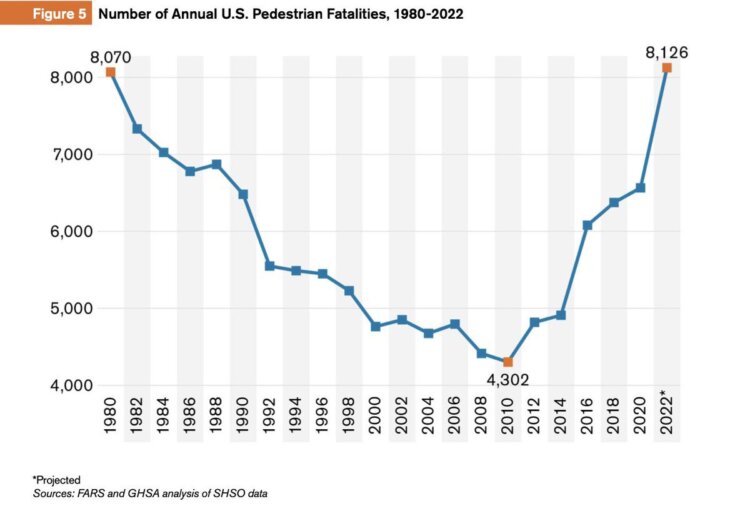
Well, there are no solid answers. Starting with 1975, the year the MOST cyclist were killed until recently, data showed that fatal cycling crashes DECREASED SIGNIFICANTLY each decade… so few cyclists were killed annually in the 80s than the 70s… fewer in the 90s than the 80s, fewer in the 2000s than the 90s… but…then… around 2009 or so….
I recently wrote about a horrible fatal crash that occurred in Wayne County, Ohio. I guess there is some confusion here. To be clear, I have NO ROLE in the Wayne County crash. I do not represent anyone – haven’t been contacted to be involved. I am simply reviewing the available PUBLIC information/data and adding my commentary and analysis based on my 44 years of trial lawyer experience handling 1000s of injury and death cases and more than 500 bike cases.
Long time readers will recall that since, roughly, 2008 I have been gathering all data on every fatal bicycle crash in Ohio. We try to get all the public records – crash report – photos – videos- toxicology – forensic reports. We review the data & try to see what happened…and whether police “got it right.” As a lawyer with a Math degree, analyzing the data, and crash statistics in general, has always been right up my alley
Often I will write about interesting crashes or cases that present issues of interest to cyclists. I don’t write about every crash, but do write in depth on some.
Over the years I had felt that police often failed to properly analyze crashes involving bicycle operators – failing to appreciate that the cyclist has EXACTLY the same right of way as the driver of a motorcycle, VW Beetle, Camry, Tundra, F350 or semi. We felt LEO’s often blamed the cyclist unfairly when the cyclist was not to blame… my deep dive confirmed that feeling. I started writing about these crashes based on the DATA we obtained.
I have handled many complex crashes over the years – taken cases to trial – worked both for and with insurance companies and as well representing the injured victims. I have worked with some of the very best bicycle crash experts in the country. I felt my trial lawyer skill set, combined with my math background and my decades of road cycling, put me in a unique position to analyze these cases. I usually do not comment or publicly discuss cases in which I have a role as an attorney. I often talk about prior cases I have handled, but not cases in which I am actively engaged as counsel. This is certainly the case here
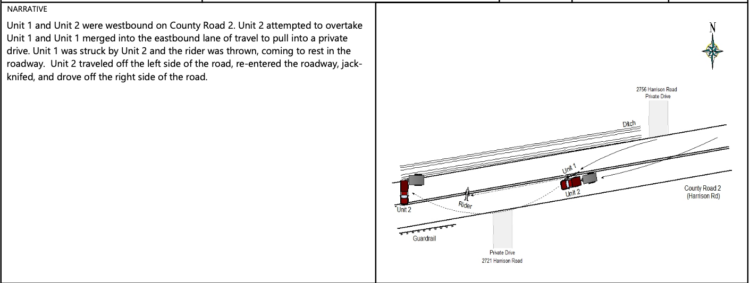
Again, to be clear – I have no role in the Wayne County crash. I am writing about it as an outsider, commenting on the data that appeared in the media, and data I have acquired through Ohio’s public records laws. My analysis is my own- based on my experience and education.We recently reported on a fatal crash occurring in Franklin Township, Wayne County. A cyclist, 68 year old Emma Miller, was westbound on Harrison Road, in Wayne County at around 4pm on a clear, sunny, dry afternoon. As she was making a left turn into a private driveway a motorist coming up behind her in a huge Ford F-350, towing a trailer, tried to pass her. The cyclist was left of center, well into her turn, when the big truck slammed into her and killed her. The truck/trailer went off the road to the left, then swung back to the right and jack knifed.
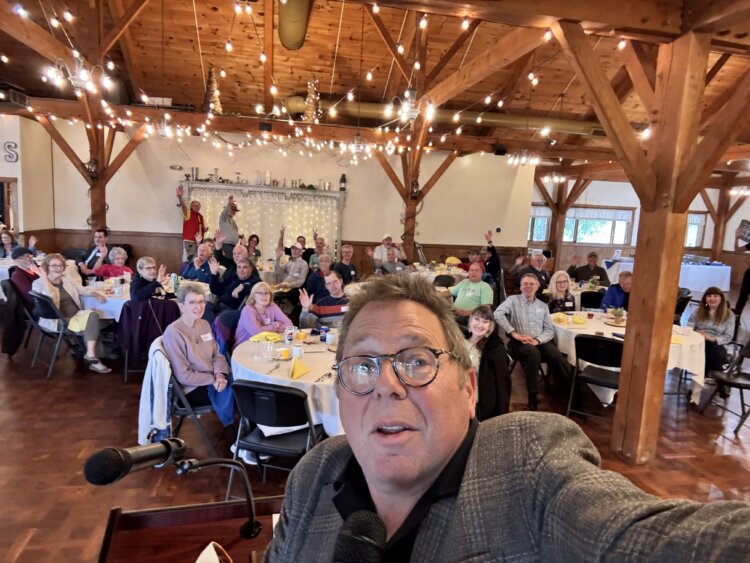
MANY thanks to the DAYTON Cycling Club for having me up to speak at their Annual Meeting on Sunday. I was so excited to get the call – come to Young’s Dairy? OF COURSE… Speak at the Meeting? OF COURSE.
I went up Sunday night and they had a nice lively crowd for dinner. After the business of the Club was out of the way I was able to talk a bit.
When I was asked to speak I explained that I had a 3 hour Legal Ed class which I sometimes shrunk to 2 hours. I could cram it into 1 hour but it was tight… they said “Best we can do is 20 minutes…”
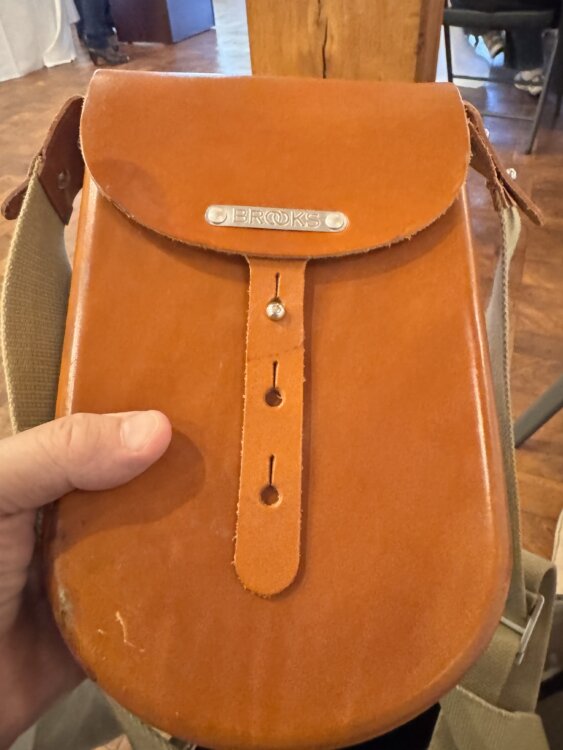
I re-tweaked my thinking and talked about how I had crammed “The DNA of the Cycling Advocate” into this old Brooks bag…
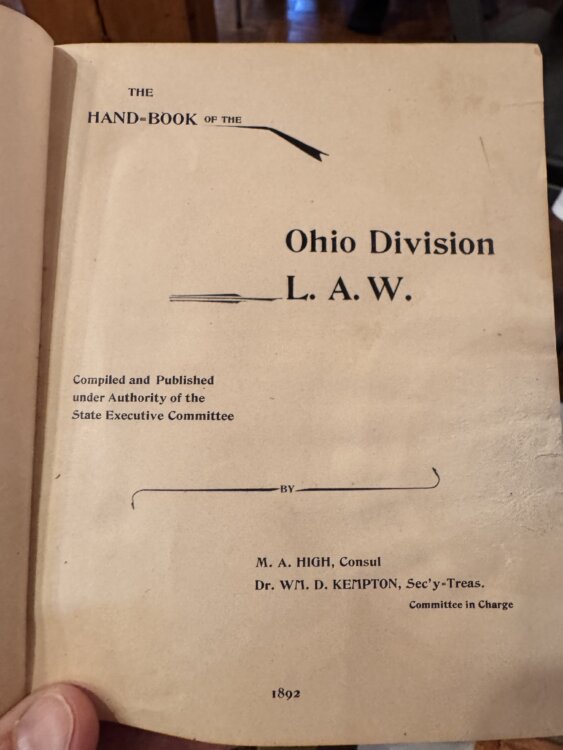
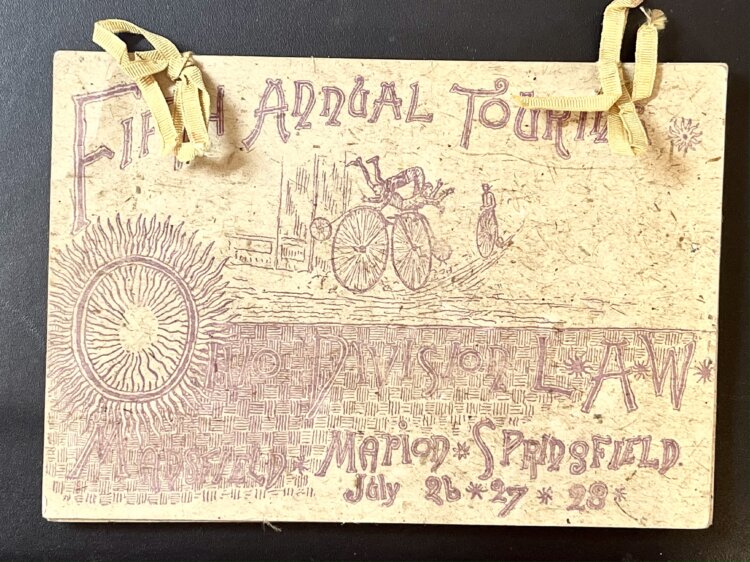
Nobody could quite guess what was inside… Even with a hint [something from the 90s] nobody figured it out…so I pulled out a 1st edition of the LAW’s Ohio Division Handbook… published in Cincinnati in EIGHTEEN 92. I guess I could have added THAT tidbit to the hint…
To me, the DNA of the cycling advocate started when people started organizing – the LAW [League of American Wheelmen, now the League of American Bicyclists] was started by a bike maker & his lawyer in 1880. Ohio, a hotbed of cycling activity, had a number of clubs pop up at the same time, including the Cincinnati Cycling Club, founded in 1880 as well.
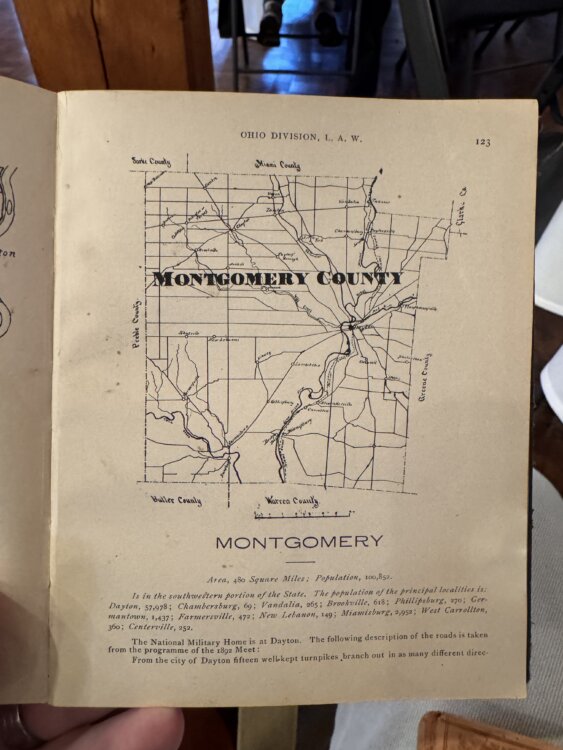
By 1892 the LAW & Ohio clubs were able to publish this little book which had a page for each of Ohio’s 88 counties complete with a map of the best cycling roads and route recommendations, restaurant and hotel listings, warnings about bad roads and mean dogs, and more.
PASSION fueled that book project – a Passion to Ride – can you imagine what it took in 1892 to gather the data from 88 counties and put it together into a book? The book was published in Cincinnati and widely distributed. The 1st edition I have a bit worn, it looks like it traveled with its owner as he or she tested out the roads around the state.
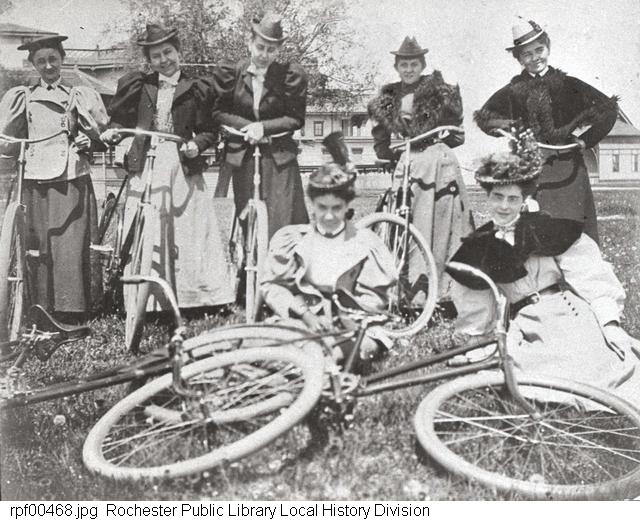
The LAW helped combine that Passion to Ride with a PASSION to PROTECT our right to ride. The LAW was at the forefront of many of the big legal battles involving cyclists. In that period – the end of the Victorian era – cycling took over the world! It dominated the society pages, sports pages, and more. Cycling had a huge influence on women…and even women’s fashion as men challenged a woman’s right to wear what she wanted when riding her bike!
By 1895 enough litigation had occurred involving cyclists that a Wisconsin Bike Lawyer, George Burr Clementson, was able to publish the 1st Bike Law case book. I have a 1st edition of that epic tome in the bag as well. The RIGHT to use the roads on a bike was not well established until lawyers throughout the country took up cases for cyclists and generated decisions protecting that right. Traffic cases, criminal cases, civil cases… Clementson cataloged them all in a small case book, which fit perfectly in the Brooks bag.
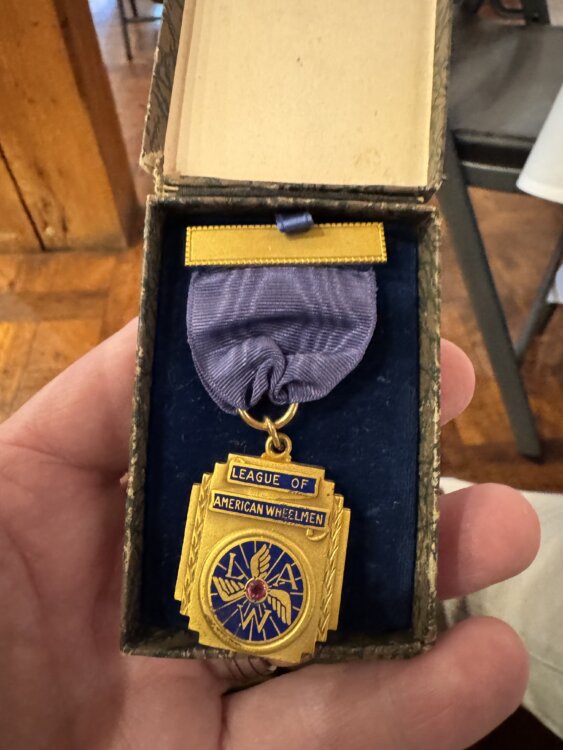
Also in the bag – a ruby pin – a prize from an early 1900s LAW sponsored event. LAW controlled Racing and promoted riding throughout the country.
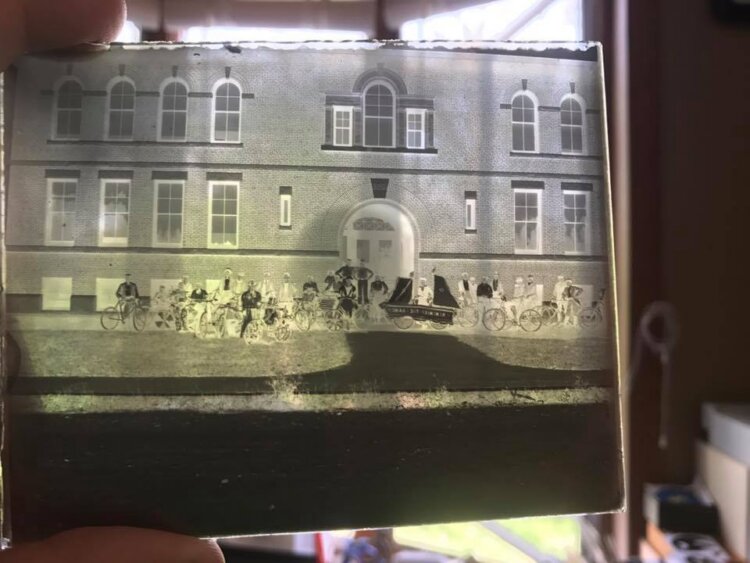
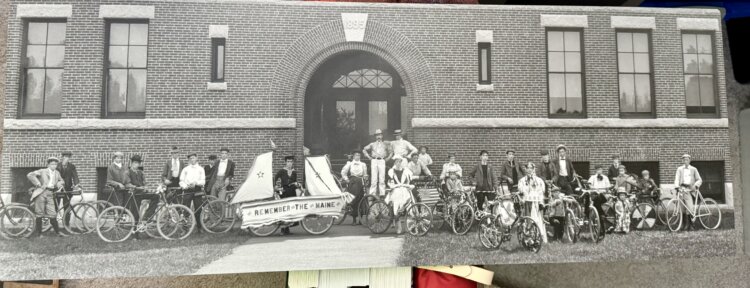
I also added a glass negative from a photo taken in the early 1900s of a group of cyclists at a parade or memorial event – the theme was REMEMBER THE MAINE -with one fellow in his best Teddy Roosevelt costume… a reminder that cycling and POLITICS were intermingled early on. I found the glass negative on eBay & had it printed on metal.
I had that old negative cleaned up and printed, on metal, by a fantastical local printing company and I brought the big print as well.
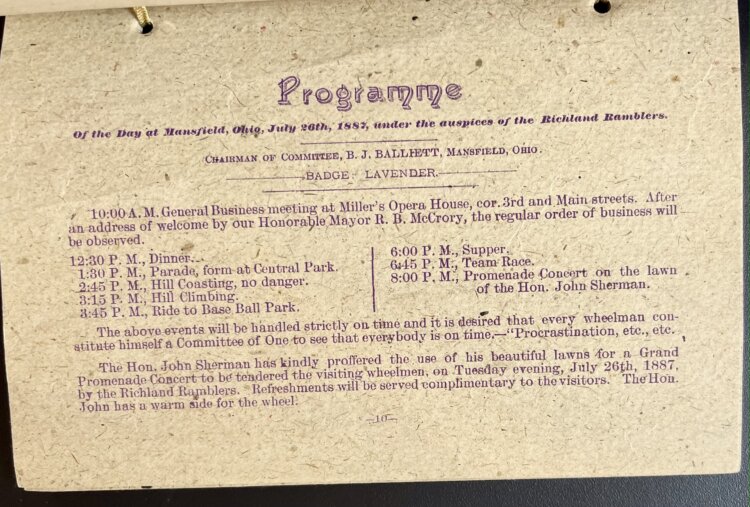
The LAW was very powerful during this late Victorian era. In my old hometown of Mansfield, OH the LAW held an big event in 1887! I was able to acquire a very cool photo from that era along with some “ephemera” from the event. This stuff is cool to me – it makes it so much more REAL than looking at a picture book… real people were riding bikes and organizing massive events because of their PASSION for CYCLING.
As we tend to do today, the 1887 riders gathered for a group photo. In 1887 they gathered at the house of U.S. Senator John Sherman. When I was growing up in Mansfield in the late 60s/early 70s everybody knew where the old Sherman House was but it took several more decades to understand that John Sherman was a FORCE… the younger brother of Union Civil War hero Gen. Sherman he was a lawyer who went to Washington and became a Senator, Secretary of State and Secretary of the Treasury! His name adorns “The Sherman Act” as the primary author.
By 1887 you can begin to see the changes in cycling gear in this photo… the move from the PennyFarthing to the Safety bike began around 1880…I’m sure some of the folks, mostly stubborn older men, were hanging on to their Old School big wheels while the young hip crowd began riding the Safeties… HA
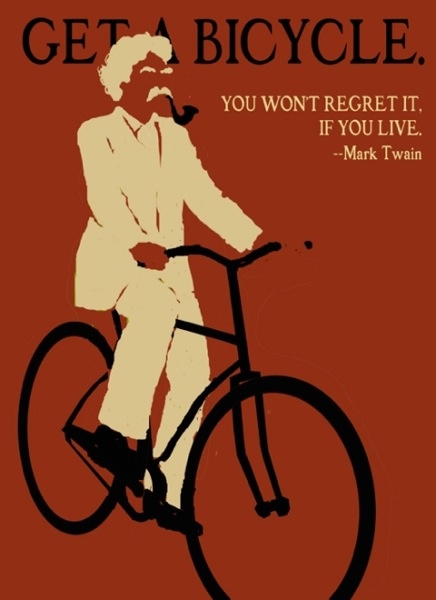
These cycling changes in the 1880-1900 time frame were critical to the advancement of cycling. Cycling went from something crazy – flying along high atop a 60″ wheel – to something easy and fun – sitting astride a Safety. Mark Twain wrote about learning how to ride a wheel – in his essay “Taming The Bicycle” it was “not quite a full-grown bicycle, but only a cold – a fifty-inch, with pedals shortened to forty-eight — and skittish, like any other colt.” Twain wrote about his trials and tribulations – and his MANY falls, including while trying to simply dismount… “Try as you may, you don’t get down as you would from a horse, you get down as you would from a house afire!”
Twain’s parting words are teh stuff of modern memes galore: “Get a Bicycle. You will not regret it, if you live.”
WOMEN
Women were, and are, very smart. They look at these newfangled things- they assess – they perform a careful risk analysis and, generally, women in the 1880s were content to NOT ride the BIG wheelers as they watched men topple and crash. Rather, when the Safety Bicycle was developed for the masses Women went for the bike in a BIG way.
Here, finally, was something useful for women. Something anyone could ride safely. You could move about your community, or to over to the next town, aboard this metal steed that required no food, no water, no potty breaks and no clean up!
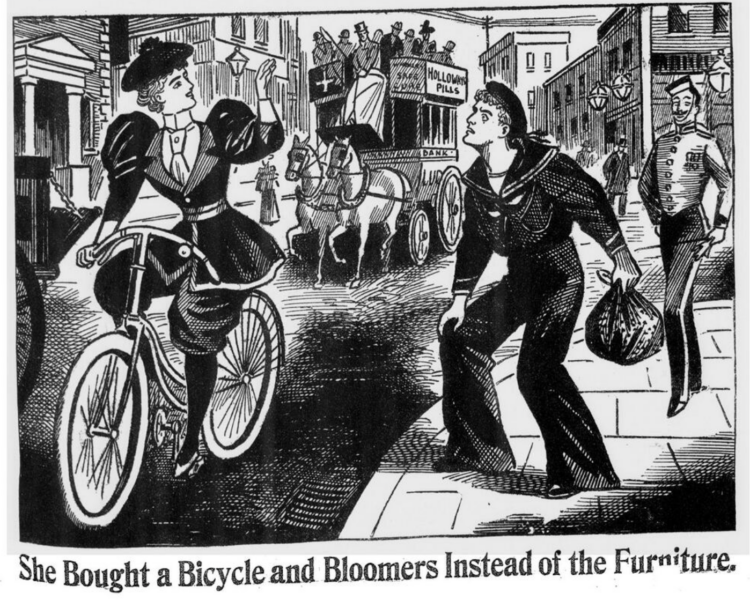
The Safety was… well… safer… Once you got the knack of it, off you went! Women flocked to the bike – Women’s FASHION was impacted because the typical Victorian Era garb was NOT suitable for riding – so Women started a movement – maybe the Bloomer Movement isn’t quite right but they started riding in clothing that made sense for the BIKE. And at times the Men decidedly did not like it.
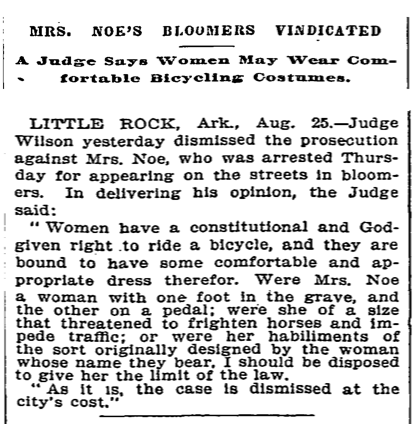
Cases were brought over … BLOOMERS… in 1885 Mrs. Noe’s Bloomers were VINDICATED in Little Rock.
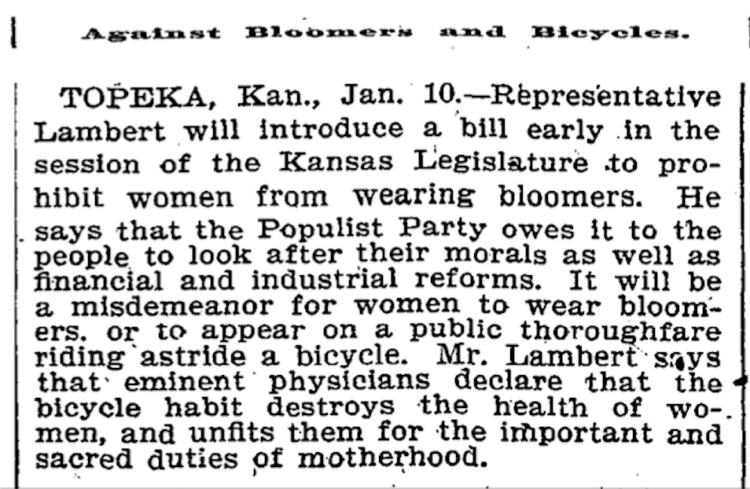
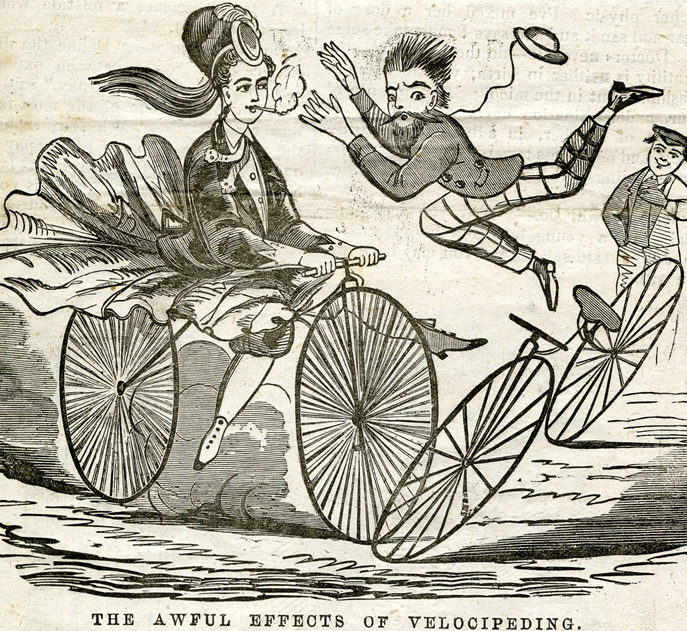
In 1895 a Kansas representative introduced a bill to PROHIBIT women from wearing bloomers on their bikes. Men, including physicians, argued that cycling “destroys the health of women” and “unfits them for the important and sacred duties of motherhood…”
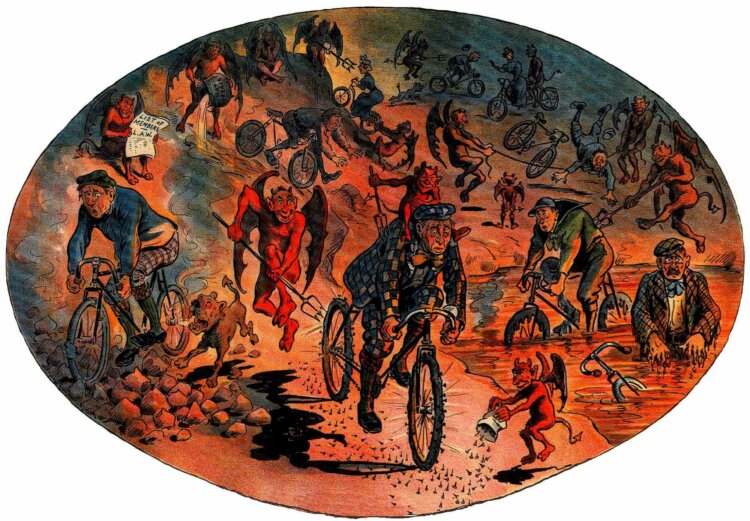
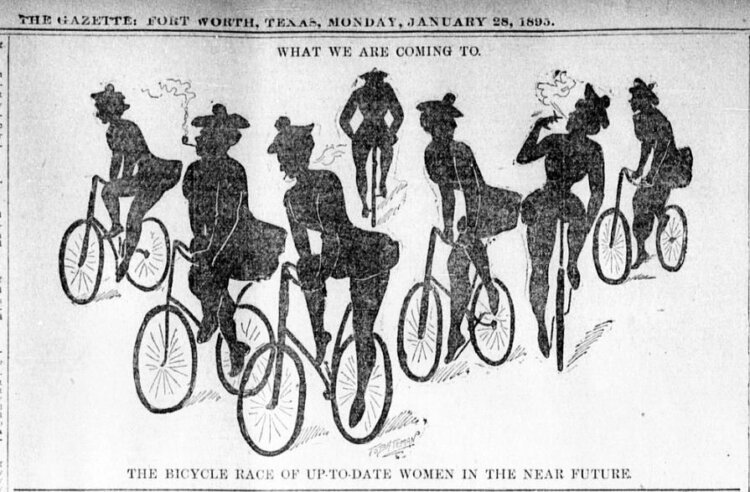
Women, of course, were not having any of it. They kept on buying their bloomers and cycling specific clothing and kept on riding. It became quite a “thing” this damnation of the Bike by politicians and physicians and pastors in the pulpit! The argument that cycling was a vice which would lead to smoking and drinking and all sorts of other vices was not unpopular among certain folks in society. Pastors would preach that cycling would take you straight down the road to Hell!
11.10 Bicycle Hell (from “Puck”) Source: Library of Congress Format: RGB tiff
In the 1894 Oberlin College Yearbook there are many ads for all the cool hip toys that the kids were asking for… Typewriters… Cameras… and BIKES
However, it took some years for the image of cyclists, particularly women on bikes, to become…socially acceptable…
And… of course… women persisted… they continued to ride in bigger and bigger numbers…
In this political cartoon on Equal Electoral Rights for Men and Women from New Zealand the hip cool woman on her safety bike was teasing the old Grandpa on his old fashioned, by then, big wheel
the makers of bike stuff took notice and soon women could buy their specially tailored bike suits, some complete with Pistol Pockets, for help on the road!
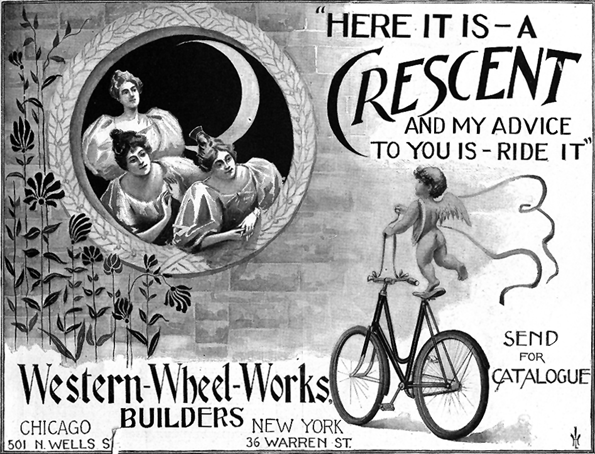
Makers of bike stuff made women’s bikes and special cycling shoes for women too. In deed, the impact was recognized an 1896 article in The Cycling World Illustrated!
Women rode for pleasure and fun and fitness and even… for work. Belva Lockwood was among the first women to practice law in D.C. and the first to appear before the Supreme Court. She saw other lawyers, men, using the bicycle to move about the city more efficiently and she took up The Wheel – in her case a Tricycle to accommodate her long black velvet garb. Belva’s riding supposedly caused SUCH a stir that the President issued an edict that none of the wives of his Cabinet officers were permitted to ride.
Women formed and joined cycling clubs. The Ohio Handbook has many such clubs listed. In this shot, from Oberlin, you might recognize the sister of the world’s most famous bicycle mechanics…
GOOD ROADS MOVEMENT
I also talked about The Good Roads Movement- a political movement that saw cyclists and farmers and commercial enterprises promoting candidates who promised to pave the roads. I’ve picked up several old copies of Good Roads, published by the LAW in the 1880s. Gotta love that promotional piece in the upper right corner… If people “…have no roads they are savages for the road is the creation of man and a type of civilized society…” Cyclists were BIG in the Good Roads Movement as they fought to get old muddy ruts paved for smooth riding.
So the DNA of the Cycline Advocate is made of the FUN and EXCITEMENT one experiences on the bike and the PASSION for Riding and PROTECTING our Right to Ride legally & politically… Today we continue that fight to protect YOUR right to use the roads every day here in Ohio!
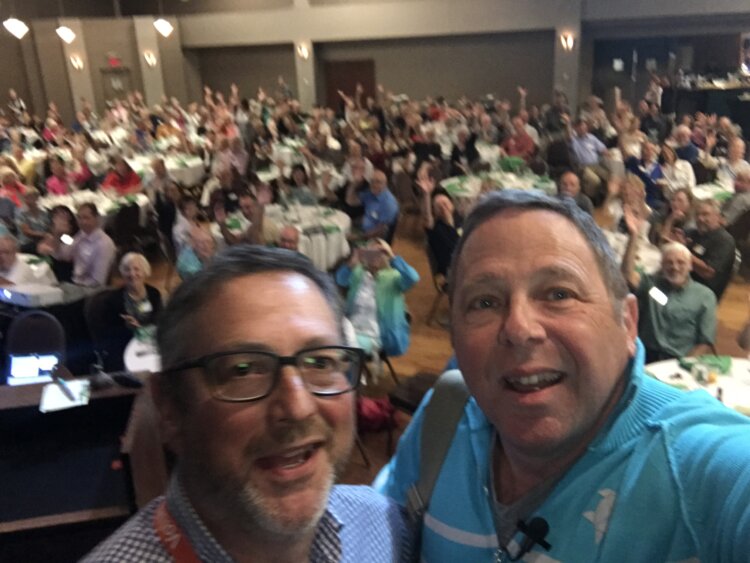
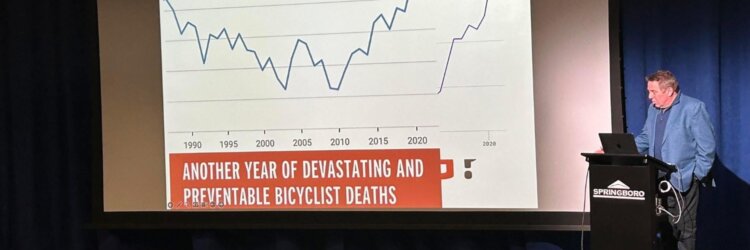
I do a number of speaking gigs each year. Sometimes I talk to community groups, like we did in Springboro last month. Sometimes it is a club dinner – big or small. Sometimes it’s a Bicycle Summit – The Oklahoma bike folks flew us out to Tulsa to speak at the Oklahoma Bike Summit. Sometimes there is a regional or national event involved, like the Tandem Group I spoke with a few years ago… I was expecting, eh, 30-40 people and …. WHOA there were 300+ in a huge room!
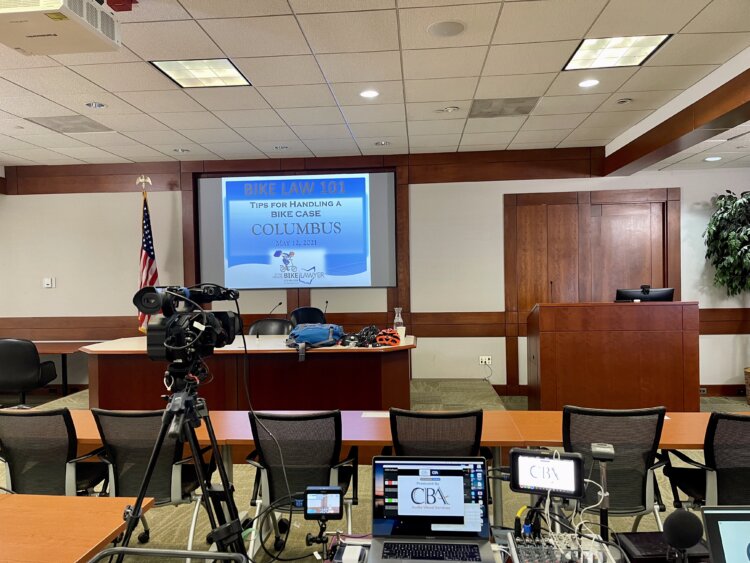
Sometimes I talk to lawyers. I’ve been giving a Continuing Legal Education seminar for lawyers and judges in Ohio for many years now: we call it BIKE LAW 101.
I’ve done an abbreviated 1 hour version of the seminar but typically we go 2 or 3 hours and cover everything from a little history lesson to laws governing riding, issues on sidewalks and trails, hot button issues the other side tries to raise, insurance issues, who to sue, how to get around “Release” forms, how to interview a cyclist & evaluate the case, how to gather data, WHAT data you need… we talk about specialized experts who can reconstruct a bicycle/car crash, and experts who can forensically extract and interpret GPS data, or data from a watch or phone… We talk about using TEXT data from the motorist…using DOORBELL cam or security cam data… there are MANY things we see in our typical bike crash cases that are VERY different from the stuff you find in typical “personal injury” cases most lawyers handle.
Talking about GPS usage has changed considerably over the years. But it can provide VERY strong data to help us prove what our client did and why she/he did it. IT can help prove that there was no “sudden” movement – no “Suicide Swerve” into a passing car. It can prove that yes, the cyclist DID stop at the stop sign. It can prove that No, the cyclist was NOT going 45 mph… We’ve learned that analyzing this data and using it in a trial or hearing requires a lot of WORK, and some specialized expert testimony.
In one recent case we combined GPS points with witness testimony and had our expert create an animation of a crash overlaid on a map, using things true to scale, that showed, in real time, that the car seeking to pass the cyclist had PLENTY OF TIME to see that the cyclist was moving right to left, aiming at a left turn, and to react to avoid a crash. Instead the motorist chose to SPEED UP, exceed the limit, then proclaim surprise when he whacked, and severely, catastrophically, injured the rider. This was helpful in getting the Simply Fabulous insurance company to from ZERO to more than TWO MILLION DOLLARS during the course of the Mediation.
Whenever I speak I bring along this nice Brooks bag. I am not sure what it is designed for today, but it looks like a bag that cyclists could been used back in the 80s/90s [the EIGHTEEN 80s/90s] to carry around some books relating to cycling.
One of these is a book published by the Ohio Chapter of the League of American Wheelmen in 1892. The other is the first published “Bike Law” book which came out in 1895.
The LAW book is fascinating as it lists all the clubs and big wigs of Ohio cycling in the 1890s. It goes through the national and Ohio bylaws and such, but then has a page or 2 for just about all of Ohio’s 88 counties… someone from the county provided a map and wrote up a piece about cycling in the county- good roads, finished roads, nice places to eat and stay and other fun details. I found an original 1st edition of this book at an Olde Book website.
Such a tremendous find. I found a better/cleaner original some years later which I donated to the Bicycle Museum of America, located in New Bremen, Ohio. A page discussing Stark County gives you a sense of the detail provided by this book way back in 1892!
The BIKE LAW book is also fascinating. It was prepared by George Burr Clementson, a somewhat distant relative of Aaron Burr and an early “Bike Lawyer” from Wisconsin. Like today’s case books, Mr. Clementson catalogs and organizes case law relating to riding on the roads. This is also a first edition from 1895. It’s always been fascinating to me that by 1895 there were enough BICYCLE cases that made it to the appellate system that a lawyer could find and organize them into a book! Mr. Clementson was certainly one of the very first BIKELAWYERS around.
A BIG issue then was whether a cyclist had the RIGHT to use the public roads… courts held unanimously that they did. In the 1890s there was not much in teh way of “traffic laws” and cyclists shared the roads with horses, buggies and pedestrians… leading to all the same type of complications we see today and folks ran into each other and got hurt, or fought for their space on the public ways. Cases arose against municipalities for failing to keep roads safe, and against businesses who used cyclists to deliver products. A fascinating look at the dangers of riding on the roads in the late 1800s
The Legal Maxims for the Rider at the back of the Bike Law Book are also very interesting… and topical today…
1 -Ignorantia facti excusat, ignorantia juris non excusat. A man may be pardoned for making mistakes, but not for mistaking the law
2-Sic utere tuo ut alienum non laedas. Make such use of your own property as to not injure another’s. Be cautious and prudent in propelling your bike… Volenti Non Fit Injuria – one who is the author of his own hurt has not right to complain
3 – Ex Dolo Malo Non Oritur Actio – No cause of action can grow out of a questionable transaction… when you engage in “Sunday spins” in places where such are outlawed remember you have disregarded teh law and the law may retaliate and disregard you. You’ll have to pay your own medical bills, fix your own bike and won’t be able to sue the town or an individual for your damages or injury…
4. Actus Dei Gemini Facit Injurius – The act of God does no man injury. If you are injured and negligence is imputable to no one, you will have no claim.
5. Qui Sentit Commodum, Sentire Debet Et ONus – Benefit and Burden ought to go hand in hand. Every right involves a corresponding duty. Do unto others as you have them do unto you. There is no such thing as a monopoly of rights.
6. Ubi Jus, Ibi Femedium – Where there is a right there is a remedy. BUT… De Minimus Non Curat Lex. The Law does not regard Trifles…
7. Qui Facit Per Alium Facit Per Se – He who does a thing by another does it himself – When you are acting on behalf of someone else, a city, an employer, you AND the other are liable. But “… don’t expect to recover from any one for an injury sustained by you while riding your wheel without touching the handlebars and flirting with a milk-maid in a red sun-bonnet on the other side of the fence…” [You KNOW who you are!]
Finally when you crash due to someone else’s negligence…
“The thing to do in such a case is, first, get a doctor, second get well; third –> RETAIN AN ATTORNEY TO SUE SOMEONE WHO HAD A REAL AND CAUSAL CONNECTION WITH THE INJURY, or don’t sue at all…”
Good Words to remember despite having been written 130 years ago!
So how BIKE-Y is Ohio? Well, the LAW was founded in 1880, as was the Cincinnati Cycle Club! By 1892 there were MANY clubs throughout the state – Men’s clubs and Women’s clubs. Check out this list:
I’m not sure what the number means in the 1st column…. but my GUESS is that as each club became a “League Club” with the LAW they were likely assigned a number. I know the Cincinnati Cycle Club was founded in 1880, when LAW was founded, so it makes sense that it has a very low number – 14. In just Cincinnati in addition to the Cincinnati Bicycle Club we see the Porkopolis Wheelmen [Cincinnati was know as Porkopolis due to its significant pig slaughterhouse market], the Athletic Cycle Club, the Brightonn Bicycle Club and the Cincinnati Century Club.
The Brighton Club is very interesting. This group was founded by the sons of a couple of Cincinnati’s original “Beer Barons” – Windisch & Mulhauser. In addition to pork, Cincinnati was well known for its many beer makers and breweries back in The Day. You can read about the Brighton Club here – The Leaders of the club are portrayed in this clever drawing.
I connected with one of the descendants of the founders of the Brighton Club and he sent me several scans of photographs the “boys” took… Being the son of a beer baron didi have its perks, like owning one of those newfangled Camera-thing-a-ma-bobs… The Brighton Club had a very cool clubhouse.
They used to ride a lot in Butler County, which is the county north of Cincinnati. I wondered about that for a long time & a few years ago I ran across an article in a BEER publication of all things that explained it. The early beer barons were into “locally sourced” ingredients long before that became a cool thing to do in the 2020s… Both the Windisch and Mulhauser families owned large farms in Butler County where they could grow their own barley & hops. The Club used to ride out to The Farm.
Of course, they would also visit a nice Beer Garden from time to time…
All in all, the Brighton Club was not much different than the social cycling clubs of today… they likely had the most modern of wheels, enjoyed the social aspects of riding as much as teh physical and liked to record their events for posterity…
The Brighton Club also used to race. Here’s a shot from The Brighton Road Race right before the start in Glendale, Ohio.
From the website above comes this story:
People were riding all over Ohio in the 1890s. So many people were participating in the sport, both by riding but by joining the LAW and working on ADVOCACY issues, that the LAW published an entire book featuring all the great riding throughout Ohio… To ME, that makes Ohio pretty darn BIKE-Y!
The crash happened on a 2 way city street – a very WIDE and unusual street, as discussed below.
The 18 yr old Jeep driver tried to pass the cyclist and struck him at, probably, 40+mph. You can see the point of impact next to the headlight and the subsequent points of contact on the front fender, mirror, rear door… there’s also a big dent in the A pillar from, probably, the client’s helmeted head, which led to a significant TBI – the rider suffered catastrophic injuries here….
On top of that, Jake at the Simply Fabulous Insurance Company advised us that they were DENYING the claim on Day 3, while the client was still in a coma.
Why?
Well, the police decided upon 5 minutes or so of their arrival that …!!TA DA!!… the cyclist was at fault for a “suicide swerve” during a “U-Turn” – this came from an “eye witness” who was 150+ feet away, coming in the opposite direction, around a blind curve… but … I digress…
After the impact, the Kid in the Jeep went left of center, hopped a curb and slammed the Jeep into some short concrete steps in the front yard of a house.
When the Kid got out and came back to where the cyclist was lying in the road a witness indicated he said “What happened?” But, after the crash, while the police were milling around, the witness huddled up with the Kid and …!!TA DA!!… when the kid told police his story it matched the witness… suicide swerve/U-turn… How about that?
However, the Kid also told police that he had sped up to pass, exceeding the 35 mph speed limit… which was helpful in the end. He also admitted the pass attempt occurred in an intersection – a No No under state traffic law… As for Ohio’s the three foot law, he was kind of stuck… was he giving the rider 3′ and the rider “suddenly swerved” to the left MORE than 3 feet? That seemed a bit far fetched… but the cops didn’t really inquire – they took the word of the “eye witness” that there was some kind of suicide swerve & wrote it up that way.
Police DID map the scene using the Total Station. The Total Station is like a laser-guided surveying device. Once it is properly set up police will take measurements of different critical pieces of a scene to generate data that can be used to prepare a scale replica. This takes the scene image from the old school “NOT TO SCALE” pen/straight edge to the 21st century where you have a laser-measured scale drawing.
The client’s brother had been in a bad bike crash down in Georgia some years earlier &, while the client was still in a coma, the client’s wife got a referral from the Georgia bike lawyer to… !!TA DA!! us here at the Ohio Bike Lawyer’s World HQ high atop Mt. BikeMore –
I brought in Chris Carville, the Kentucky Bike Lawyer – we co-counseled this case.
Since SF denied the claim they also denied us the opportunity to inspect the car so we sued immediately & obtained a TRO – Temp Restraining Order – prohibiting any work on the Jeep until our expert could inspect it.
We also had our expert examine the bike and, more importantly, the client’s GPS, which police…!!TA DA!! … IGNORED…
The Garmin was a Gold Mine…
We spent two years aggressively litigating this case. We sued the driver, the Kid, and his mom, who owned the car. We also sued the client’s UM carrier, which ended up being the same company that insured the vehicle. The case was… vigorously… defended by defense counsel with whom we were quite familiar. This is helpful, I think. They knew us, we knew them. They knew we knew what we were doing on this bike stuff and we knew they knew how to defend and work a case.
Extracting phone data is complex and we eventually negotiated a protocol to obtain the Kid’s phone data which was… also a Gold Mine. The data showed… !!TA DA!!… the Kid was TEXTING HIS GF right around the time of the crash…
We also obtained 40+ hours of cruiser/body cam footage. This proved to be extremely helpful for unexpected reasons.
Because police decided early on that this was NOT going to be a situation leading to any criminal “charges” we believe they were far more lackadaisical in their data/evidence collection than if they were thinking about felony traffic charges. We found critical witnesses on the body cam who were not even mentioned in the 50 page crash report. One Key witness, for us, was simply … !!TA DA!! … completely IGNORED by police. He was questioned for less than 20 seconds – gave his name and told police he was coming the opposite direction from the cyclist & Jeep. He said he was near/next to the crash scene when he HEARD the big impact. He looked in his mirror and saw our client flying in the air!
He stopped his car, got out & ran back. Meanwhile, the Kid had gone left of center and crashed the Jeep into a couple concrete steps in the front yard of a house 100+ feet down the road from the point of impact. The Kid came back to where our client was lying in the street [about where the helmet is placed in the photo] and said “what happened?” -He didn’t know what had happened…
In the photo above you can see how far down the Jeep ended up. You can also see the van-type vehicle sitting first in line. This was the “eye witness” – a word I keep putting in quotes because we came to seriously question what exactly the eyes of this witness could have possibly seen. As you can see by the line of traffic, the road bends around under the overpass. The van was coming out from under the overpass before the crash – the driver said he stopped where the van is shown as the Kid drove the Jeep into his lane. The Jeep hopped the curb and hit the steps. So how much of the critical seconds leading up to the crash could the driver of the van have seen? Virtually nothing.
After the crash, while the police were milling about, the Kid huddled up with the witness who said the cyclist “swerved” into the car during a “U-turn.” They were talking several minutes. One of the officers noticed this and pointed it out. She felt the two could be cooking up a story, and the body cam picked up her concerns – but the officer in charge didn’t seem concerned…they had already decided it was the cyclist’s fault and when they finally asked the Kid what happened … -suddenly the kid said the same thing as the guy in the van – the rider did a suicide swerve in a U-turn… !!TA DA!! See… Kid’s OK, Cyclist is at Fault…
As we dug into the police video we saw that one Cruiser cam angle also showed, in the background, the Kid’s dad getting 2 big dogs out of the car.
As the case developed we learned what the Kid had been doing that day through depositions, and a review of his phone data. The Kid was a senior in high school and this had been an off day so he was at home. Dad had gone to his shop/office with the 2 dogs. Dad called the Kid & asked him to come to the shop to A/pick up the dogs and B/pick up some tax forms to take to the CPA. Because much of this was set up through text messages we have a pretty good timeline.
The Kid had picked the dogs up from Dad a few minutes before the crash along w some papers he was taking to a CPA. From Dad’s shop to the crash site was less than 5 minutes. The crash time, on the police report, was listed at 1345. This ended up be a VERY important data point.
The Kid had a map app open on his phone to help him get to the CPA office. His phone was likely mounted in a cradle that was stuck to the top of the dash, further blocking his view of the right side of the lane ahead, where the cyclist was riding.
In a deposition 2 years after the crash the Kid initially said he thought the dogs were in the back end of the Jeep, but … we had a photo from police showing the back was filled w golf clubs and sports gear & he had to admit the dogs were closer. In fact, the cruiser cam video showed one of the dogs getting out of the FRONT seat.
Combining the phone data and time stamps with the GPS data, 911 calls and police officer’s laser mapping [confirmed by our expert’s own laser mapping] along with the testimony of our newly witness about the car in the opposite lane & the Kid’s admission of speeding and passing in an intersection, we were able to put an animation together for Mediation showing how easily the kid in the Jeep could have AVOIDED the crash by…gasp… paying attention and slowing down.
The video shows the path of the car, at different speeds, and the path of the BIKE mapped out through GPS coordinates. It shows them meeting at the spot that our expert determined was the point of impact.
The geography of the area also came into play here. As noted above, the street here was both “wide & unique.” The street had 20 FOOT lane width on both sides- highly unusual for a city street… However, this street was unique in that the eastbound lane, where the Jeep and bike was traveling, actually ENDED and the road turned into an on-ramp for a higher speed limited access highway where bikes are not permitted. The west bound lane actually started at the end of an OFF ramp from the same limited access highway.
This aerial shows in red path of the witness, the client on the bike and the Jeep. The witness coming from the offramp. The bike’s path was right to left towards a left turn into the side street. The Jeep’s path was coming from behind the bike. The length of the lines represent the approximate distance traveled by each vehicle in the final FOUR SECONDS before impact.
Clearly, the client’s intent was NOT to go up onto the limited access highway where bikes were banned. The client’s right-to-left movement on the bicycle during that final four seconds was consistent his lawfully riding “to the right” initially and then preparing for a left turn across the oncoming lane and into the small, short dead-end side street shown in the video. In fact, the client’s GPS had mapped out MANY prior rides over this same route where the client had made a left turn into the side street to turn around and go back the other way.
The client had no memory of the crash or his intent or actions. His only memory was of the bicycle suddenly being shoved out from underneath him & him being in the air… His next memory is several days later… without the high tech bike GPS data providing us with a window into his movement we very well may have struck out in this case.
However, with all the data we accumulated, we were able to retain experts to powerfully show that the Kid was likely distracted- he had the 2 big dogs- he was reading texts FROM his girlfriend – his last text TO her prior to the crash said “Have dogs in the car with me wanted to show” -this text was sent at 1:45 – the exact time listed as the time of the crash in the police report. We argued that he was clearly lining up a selfie with the dogs, or preparing a video call or some other way of “showing” her the dogs. He was likely on the very wide street where the crash occurred when he sent that last text and may have been surprised to realize: – Hey there’s a cyclist – Hey there’s a car coming in the opposite direction – Hey I have to EXIT up here so the lane next to me is going to go away – Hey that cyclist is moving right to left – Hey, I’d better speed up and pass, but I can’t go over too far to the left because there’s a car coming but I have to get by quickly and get back in my lane to get up on the on ramp so I’ll just squeeze between this cyclist & the oncoming car…
So he speeds up – to a speed exceeding the speed limit – and he clobbers the cyclist, who has the right of way and the right to make his left turn after the oncoming car goes by.
Had the Kid simply realized a couple seconds EARLIER in the traffic game what he was facing ahead he could have slowed down…for a SECOND OF TWO… and passed safely – There was 15-20 feet of wide open space to the RIGHT of our client at that point, but the Kid was negligently committed to passing… Had the Kid been paying attention our client would NOT have suffered life changing, catastrophic injuries…
Combined with the speeding admission, passing in an intersection, failing to give 3 feet of clearance, having 2 bigs dogs running free, and other admissions of careless behavior, we were able to make a very strong argument that the kid was negligent… & that our client was NOT!
We also aggressively worked up the Damages side of the case, retaining experts to review the medical side of the head to toe neurological and orthopedic injuries… we had animations put together using the 3-D imagery done during MRI and CT scans at the hospital – amazing stuff that showed how very badly the client’s hip, shoulder & scapula were permanently maimed in this crash…
In the end we mediated the case and SF went from “We Ain’t Payin'” to “How Much…” and a significant figure was paid to resolve the claim.
In addition to working with cyclists here at the BikeLawyer’s World HQ we are also involved in Pedestrian Safety & Advocacy. I’m working on an article now called “The Law of Walking Around” which will trace a bit of the history of pedestrian laws and discuss the WEIRDNESS of current pedestrian laws in Ohio as well as current trends in pedestrian safety.
The local public TV news folks at WCET reached out to me as they are doing a piece on pedestrian & bike safety so I’m doing an interview with them this afternoon – should be interesting!
Statistically Ohio remains a SAFE place, generally, to ride a bike and walk around compared to other bigger states …but… we want MORE… and…
Ohio is also mirroring the national trends – MORE crashes and MORE deaths of cyclists and riders… a trend that started back around 2009 for ALL vulnerable road users, including motorcyclists…
Every once in a while these articles come out ranking the “Most Dangerous Cities” for cycling or walking … Here’s the latest…
No 1 WORST for WALKING? From this article that title goes to…Ta Da… Albuquerque, NM, based on 9.24 fatalities per 100,000 people.
The rest of the list is a bit surprising… After Albuquerque there is Memphis, Baton Rouge, Miami and Lexington, KY?
The “rate” of fatal crashes is what they look at, not the total number. For total numbers, Florida leads the league… by a LOT – and has for many years. There are still Florida cities within The Most Dangerous – Miami is no. 4 on the walking list… Lexington is there because it had 49 car crash fatalities, which is not a big number, but 22 of those were pedestrians! Lexington’s fatality rate for pedestrians is 3x the national average
In Ohio, Cincinnati was the “worst” as it ranked 37th nationally with a rate of 3.55 deaths per 100,000 people. Next was Cleveland at 3.27 and then Columbus at 2.65. Nationally, the US Rate 2.21 deaths per 100,000 people so all 3 Ohio cities were worse than the national average!
Some [bad] numbers about driving in the US… Car crashes now kill OVER 40,000 people every year in America – car crashes have become one of the leading causes of death in this country. There are some 6,000,000 car crashes every year that result in injuries and property damage (and we wonder why auto insurance costs so much).
CRASH DATA FROM FARS/NHTSA: ~ 19,937 motor vehicle crashes occur every day in the United States. – There are around 118 deaths caused by auto accidents each and every day. Imagine a 120 seat airplane crashing…due to negligent pilot behavior… every day
Injuries: An estimated 6,849 injuries happen each day due to car accidents.
In 2022, a total of 42,514 fatal car accidents occurred on roadways across the United States. Another 1,664,598 crashes resulted in injuries and 4,226,677 caused property damage. In all, the number of police-reported crashes that year hit 5,930,496. – Forbes
From 2018 to 2022, the number of deadly accidents in the United States increased by more than 16% — from 36,835 fatal car crashes in 2018 to 42,795 fatal car crashes in 2022. 41,000 people were killed in US car crashes last year (2023). – USA Today
NHTSA has now published 2023 FARS data and the numbers are NOT any better. In the 30 years from 1994-2023 a total of 1,176,187 people have been KILLED on US Roads. That many people would be the 10th largest city in the US…
Ohio is seeing comparable problems – 1100 people are killed on Ohio roads each year. There are 250,000 car crashes involving over 500,000 people.
Traffic Deaths bottomed out in the US around 2010, dipping just slightly below 33,000 for a couple years and then started climbing, and climbing and CLIMBING. From 32,479 in 2011 to 42,471 in 2022. 9,992 more deaths today than in 2011 a whopping THIRTY PERCENT INCREASE in a decade
Why?
That’s worth studying – social media started, and blew up in this time period… as did the development & sale of phones capable of doing a lot more than making phone calls. Suddenly, from your car, you could receive & review a fax or spreadsheet, search the World Wide Web, go online to look at a menu, watch TV or a Movie, take a photo or video, download data, upload to any of the dozens of media pages… all while “DRIVING”… and did car makers take steps to stop this? Ummm… NO… the InfoTainment systems that used to just play music now have screens the size of large iPads and have become CRASHerTainment systems…
The bottom line is that people SUCK at driving cars – they run into buildings – poles- curbs- other cars and people on bikes or motorcycles, as well as people just walking around – People in the US drive their cars so poorly that they are killing others in record numbers… it’s more than an issue, it is a public health problem. What’s the answer? I’m not “carceral” per se, but I think if people knew there would be STIFF punishments for careless driving they’d be more…careful… but that’s just me…
In some places there is so much concern for E-BIKES that they are passing local laws prohibiting them, or allowing forfeiture/impoundment… I’m really NOT against that…for cars…
Perhaps just having in the law the ability of LEOs or the Courts so simply lock up their cars for a time will slow folks down – I dunno – SPEED is clearly the problem. Speed KILLS… and the current “system” of safety by ticketing is failing everyone…and the answer is NOT “get everyone ELSE off the roads so cars can go even faster” – the answer is slowing down traffic so motorists kill and maim fewer people – if allowing the government to impound cars for a specified term gets that job done, I’m all for it…
While I was in DC many years ago for the National Bike Summit I met Eleanor McMahon, a Canadian visitor who tagged along with the Ohio contingent. Her story was a very sad one. Her husband was a cyclist, and police officer, who was killed while riding [off duty] on the road. The motorist was not licensed. He had over 5 license suspensions – and multiple crashes. She did some research that showed an extraordinary percentage of people drive on suspended licenses. She developed a bill called Greg’s Law, after her husband. This bill substantially upped the penalties for repeat offenders – fines up to $50,000 – and imposed a 7-day Impoundment of the offender’s vehicle. Sort of a cooling off period, which has been effective. Eleanor was a very effective advocate for us in DC and for her constituents later when she was elected to government in Canada!